|
|
|

History
The TurboXS DTEC (Data Transfer Engine Console) is one of the strangest Game Boy accessories ever made, and a genuine piece of car tuning history. Released in October 2004 by TurboXS, a Maryland tuning company, it used a Nintendo Game Boy Advance SP as the screen and keypad for an engine computer that could control boost, adjust fueling, display gauges and log data. This page covers both sides: what the DTEC does for your car, and why it’s a fascinating oddity for Game Boy collectors.
The DTEC as made by TurboXS, a company founded in 1999 by Jermaine Riddick which specialized in application-specific performance parts for cars such as Subaru, Mitsubishi, Mazda and Hyundai. 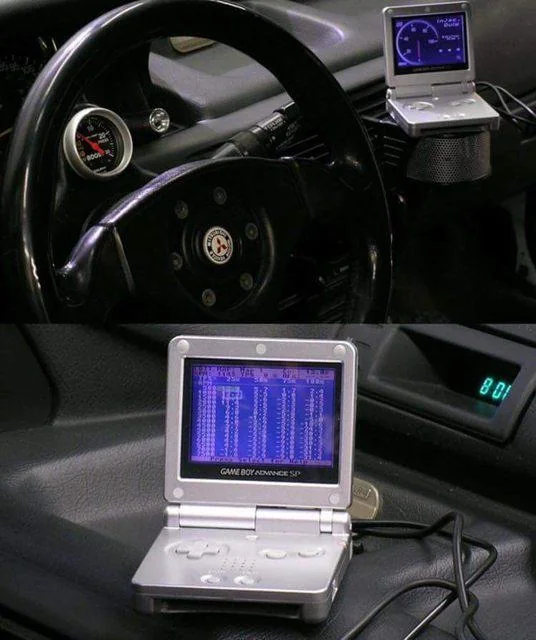
In the early 2000s, putting a color screen and buttons into a small electronics product was still expensive. Some companies got creative and used existing game handhelds as ready-made displays. Nintendo’s own JN-100 sewing machine, controlled by a Game Boy, is a famous example. TurboXS took the same approach: instead of designing its own screen, the DTEC borrowed one that millions of people already owned.
The DTEC launched in October 2004. It was well publicized in tuning forums and even in gaming press, where IGN reported in 2004 that TurboXS was considering a Nintendo DS version. TurboXS was quoted at the time: “We could make it work on the DS… I don’t know what additional programming [is required] to use both screens.” That version never came out.
The DTEC was a niche product, and it was not cheap. In forum discussions at the time, buyers compared it with established units like the Greddy e-Manage, and price was the most common complaint. Supporters pointed out that the DTEC bundled a full gauge set and data logger, which most rivals sold separately.
What the DTEC Does
The DTEC is a small box wired into the car’s sensors and ECU. The Game Boy plugs into it and becomes the display and controls. Depending on the version, it can work as:
- An electronic boost controller: it drives a boost control solenoid to hold a target boost pressure on turbocharged cars, with a “scramble” mode for temporary high boost.
- A piggyback fuel computer: an “interceptor” in the same family as the Apexi S-AFC or the Greddy e-Manage. It doesn’t replace the factory ECU. Instead, it raises or lowers the engine load signal the ECU sees (MAF, MAP or air flow meter), which changes how much fuel the ECU delivers.
- A digital gauge cluster: boost, RPM, throttle position, air-fuel ratio, injector duty, knock and more, shown as round gauges, a text “dashboard” or a scrolling log.
- A data logger: it records every channel to replay later, which is invaluable when tuning.
TurboXS’s own manual is blunt about the risks: the DTEC “provides more than enough control to destroy your engine,” and it was recommended for off-road and racing use only.
DTEC Models and Prices
All versions share the same basic unit. Some features were unlocked in software: the manual explains that a DTEC not enabled for the fuel and boost software still lets you preview all the gauges and menus “before purchasing.”
| Model | What it does | Launch price |
|---|---|---|
| DTEC Starter | Gauges and data logging only | US$229 |
| DTEC-FC | Fuel computer | — |
| DTEC-BC / BC-PRO | Electronic boost controller. The PRO kit added the boost control solenoid, a MAP sensor and a knock sensor. | US$550 (BC-PRO) |
| DTEC-FCBC (Dtec-FBC) | Combined fuel computer and boost controller | — |
On top of that, you needed a Game Boy Advance SP, which sold for about US$99 at the time.
How It Works with the Game Boy
The DTEC doesn’t use a cartridge. It plugs into the Game Boy Advance SP’s link port, the same port used for multiplayer cables, plus a power lead into the back of the SP. When you switch the Game Boy on, it shows the usual Nintendo logo, then downloads the DTEC software from the unit over the cable. After about 12 seconds the DTEC program loads, along with your saved maps. (With a TurboXS Tuner wideband connected, startup takes about 40 seconds.)
The SP’s controls are all put to use:
- The D-pad moves through menus and gauge screens.
- A and B select and go back.
- The L and R shoulder buttons raise and lower map values in 0.1% steps (holding them speeds up to 1% steps).
- Start opens the data recorder; Select opens the main menu.
Because nothing is modified, the SP stays a normal Game Boy. Unplug it, and it plays games as usual.
Features in Detail
- Gauges and displays
- Gauge mode: round analog-style gauges for each enabled channel, with adjustable scale, divisions and damping.
- Dashboard mode: all values on one screen as live text, including the RPM, throttle and knock count at the last knock event.
- Logger modes: scrolling fuel and boost logs to help with tuning.
- Channels: throttle position (TPS), RPM, MAF/load, boost, air-fuel ratio, injector duty (or scramble switch / gear), knock level and solenoid duty.
- Fuel maps
- Up to 5 fuel maps, switchable from the Game Boy.
- Each map is a correction table of 18 RPM points by 4 throttle points, with values between points interpolated.
- Corrections are a percentage of the load signal. For example, +10% turns a 3.0 V signal into 3.3 V (capped at 5 V).
- Works with hot-wire MAF, Karman Vortex, vane-type air flow meter and MAP sensors. With a MAP sensor, a fuel-cut defender option is also available.
- Boost control
- Up to 5 boost maps, with a separate scramble target activated by an optional cabin switch.
- Open-loop mode works like a bleed-valve boost controller, with a set solenoid duty cycle.
- Closed-loop mode uses the MAP sensor to chase the target boost, with adjustable gain, feedback delay and a “spool threshold” that holds the wastegate shut to help the turbo spool.
- Advanced mode maps target boost and duty cycle against RPM.
- An optional gear-based mode: wired to the vehicle speed signal, it assigns a different fuel and boost map to each gear.
- Data recorder
- The recorder works like a VCR: record, pause, play and stop. It samples every channel every 50 milliseconds and keeps the
- PC connection
- Maps can be saved to and loaded from a PC through an RJ12 cable and a 9-pin serial adapter, using a standard terminal program such as HyperTerminal (19,200 baud). Firmware updates were free and also loaded from a PC. Saving your maps first is a must, since an update erases them.
What’s in the Box
A complete DTEC-FBC kit included:
- The DTEC unit, with the Game Boy data and power cables attached
- TPS and injector duty pickup
- KnockLite (knock indicator and shift light)
- Sensor Intercept Unit (SIU), which sits between the load sensor and the ECU
- Boost control solenoid
- RJ12 data cable and a 9-pin (DB9) to RJ12 adapter
- Power cable and a 9-volt battery clip
- Velcro for mounting, the instruction manual and an application guide with vehicle-specific wiring
Supported Cars and What You Need
The DTEC is a universal unit, not a plug-in for one model. It works on any 12-volt, negative-ground vehicle with a compatible load sensor, wired in using the vehicle-specific application guide. It was aimed at the turbocharged import scene of the early 2000s, including the Subaru WRX STI, Mitsubishi Lancer Evolution and Eclipse, Mazda RX-7, Nissan 240SX and Toyota Supra.
To run one, you need:
- A Game Boy Advance SP (the model the manual requires)
- The DTEC unit and the kit parts above
- Access to these wires: switched 12 V and ground, TPS, an RPM signal (tach or ignition), the MAF/MAP/load signal, plus optional injector and knock signals
- For boost control: the solenoid plumbed to the wastegate (internal or external) and a MAP sensor
- For air-fuel ratio on screen: a TurboXS Tuner or Tuner Pro wideband, connected to the DTEC by data cable
The original installation and tuning instructions are in the official DTEC-FBC manual (PDF), still hosted by TurboXS.
Buying a DTEC Today
The DTEC has long been discontinued, which makes it rare. It now sells to two kinds of buyers: Game Boy collectors who want an oddity, and car enthusiasts building a period-correct 2000s tuner car.
- Price: it was US$550 new for the BC-PRO kit. One unit sold for US$420 in an enthusiast-forum sale, but prices vary widely depending on completeness.
- Check what’s included: units are often sold without the Sensor Intercept Unit, solenoid, MAP sensor, KnockLite or cables, which are hard to replace.
- Check the Game Boy cable: the Game Boy leads are permanently attached to the unit, so a damaged lead is a serious problem.
- Treat it as a 20-year-old electronic part: have it installed and tuned by someone who understands piggyback fuel computers, and always tune with a wideband air-fuel meter.
- For collectors: the box, manual and application guide add a lot of value.
TurboXS DTEC FAQ
- What is the TurboXS DTEC? It’s a car engine computer from 2004 that uses a Nintendo Game Boy Advance SP as its screen and keypad. Depending on the version, it works as a boost controller, a piggyback fuel computer, a digital gauge set and a data logger.
- Does the DTEC need a Game Boy to work? The Game Boy is the display and the only way to set up and change the maps. The manual treats mounting the Game Boy in the car as optional, though: once the DTEC is set up, the unit does the work, and you can plug the Game Boy in only when you want to see gauges or make changes.
- Which Game Boy works with the DTEC? The manual requires a Game Boy Advance SP. The DTEC connects through the link port and also powers the SP through a separate power lead. Systems without a Game Boy Advance link port, like the Nintendo DS, won’t work.
- Does it use a cartridge? No. The software lives in the DTEC unit and is sent to the Game Boy over the link cable every time it starts up. No cartridge goes in the slot.
- Which cars does the DTEC support? It’s universal: any 12-volt, negative-ground car with a hot-wire MAF, Karman Vortex, vane air flow meter or MAP load sensor. Boost control requires a turbocharged engine. It was popular on cars like the Subaru WRX STI, Mitsubishi Evo and Eclipse, Mazda RX-7, Nissan 240SX and Toyota Supra.
- How does the DTEC change fueling? It intercepts the engine load signal (MAF, MAP or air flow meter) on its way to the factory ECU and raises or lowers it by a percentage set in the fuel map, based on RPM and throttle position. The ECU then delivers more or less fuel. This can also affect ignition timing, so it should always be tuned with a wideband air-fuel meter.
- Can it show air-fuel ratio? Yes, with a TurboXS Tuner or Tuner Pro wideband connected to the DTEC. The DTEC can’t read a wideband sensor by itself.
- Is TurboXS still supporting the DTEC? The DTEC is discontinued and no longer supported, but TurboXS still hosts the
- Was the DTEC licensed by Nintendo? No. The manual states that the product is not licensed or endorsed by Nintendo.
Technical Specifications
| Display and controls | Nintendo Game Boy Advance SP, via the link port |
| Analog inputs / outputs | 0–5 V DC |
| Frequency input | 0–5,000 Hz (Karman Vortex air flow meters) |
| Duty cycle input | 0–100% (injector duty) |
| Power supply | 9–15 V DC, 40 mA (without the Game Boy) |
| Fuel maps | 5 maps, 18 RPM × 4 throttle points each |
| Boost maps | 5 maps, plus scramble mode and closed-loop control |
| Data recorder | All channels every 50 ms, last 30 seconds stored |
| PC link | RS-232 serial, 19,200 baud, via RJ12 cable and DB9 adapter |
| Boost solenoid draw | About 60 mA |
Sources: TurboXS DTEC-FBC Instruction Manual (2005) · The Drive · Grassroots Motorsports forum · my350z.com forum