|
|
|
History
Amstrad was founded in 1968 by Alan Sugar (then 21 years old) as AMS Trading, later shortened to Amstrad. The company began by importing and selling car aerials, transistor radios and other low-cost consumer electronics. Sugar quickly moved into manufacturing, starting with hi-fi equipment and audio products that were sold at aggressive prices.
Through the 1970s and early 1980s Amstrad grew rapidly by focusing on affordable, mass-market electronics. In 1980 the company floated on the London Stock Exchange and continued to expand. By the early 1980s Sugar recognised the potential of the emerging home-computer market dominated by Sinclair and Commodore. Amstrad entered this sector in 1984 with the CPC 464 (Colour Personal Computer), a complete system that included a built-in cassette deck and a dedicated monitor. The machine was deliberately designed as a ready-to-use package aimed at ordinary households rather than hobbyists.
The CPC range proved successful in Britain and across Europe. It was followed by the CPC 664 and the more popular CPC 6128 (with 128 KB of RAM and a built-in 3-inch disc drive). Amstrad further strengthened its position in 1986 by acquiring the computer assets of Sinclair Research, taking over production of the ZX Spectrum line.
By the late 1980s the 8-bit home-computer market was declining as 16-bit machines and dedicated game consoles gained ground. In response, Amstrad developed an enhanced version of the CPC hardware known as the Plus range (the 464 Plus and 6128 Plus). These models added a custom ASIC with hardware sprites, a much larger colour palette (4096 colours), improved scrolling and a cartridge slot.
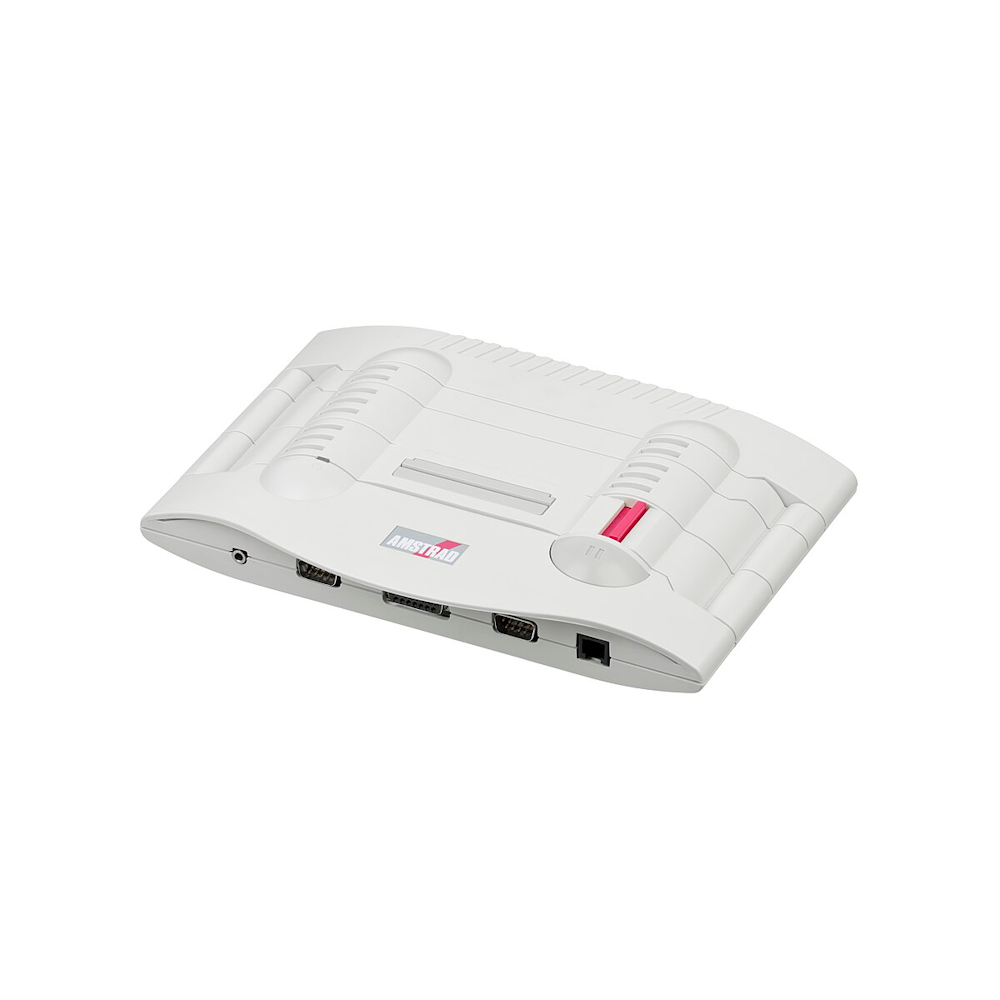
But there was no better remedy in the head for Amstrad’s executive then to fight fire with fire. To regain their market share lost to the consoles, Amstrad decided to enter the dedicated console market. Using the same upgraded Plus hardware, the company removed the keyboard and disc/cassette drives and created a pure cartridge-based console: the GX4000. The machine was announced in August 1990 alongside the Plus computers and launched in September 1990, representing Amstrad’s only attempt at a dedicated video-game console. The timing was right, their competitor (Commodore) announced at the same time their Commodore 64 Games System. Amstrad had the hardware, the experience and the games. The planets were aligned for the GX4000 to be a resounding success.
Release
The GX4000 was officially announced in August 1990 in Paris alongside the CPC 464 Plus and 6128 Plus computers. It launched in September 1990 in the United Kingdom, France, Spain and Italy at a price of £99.99 in the UK (or 990 French francs). The console came bundled with the racing game Burnin’ Rubber, two controllers and a power supply.
Amstrad marketed the system aggressively with the slogan “Bring the whole arcade into your home!” Initial reviews were reasonably positive and the hardware was competitive with other 8-bit consoles of the time. However, the machine arrived on the same month as Sega would release the Mega Drive.
Demise
Sales were poor from the start. The GX4000 struggled against the established Nintendo Entertainment System and Sega Master System, and it was quickly outclassed by the arriving 16-bit generation. Software support was limited: only 27 games were released, most of them developed by British and French companies such as Ocean, Titus and Loriciels. Several announced titles were cancelled when it became clear the console was failing.
Within months the price began to fall sharply. By mid-1991 some retailers were selling the system for as little as £30. Amstrad discontinued the GX4000 in 1991 after selling an estimated 15,000 units, making it one of the least successful consoles of its era. Amstrad would never make a video game console again.
Technical Specifications
- CPU: Zilog Z80A @ 4 MHz
- RAM: 64 KB
- VRAM: 16 KB
- ROM: 32 KB (system)
- Graphics: Custom ASIC with hardware sprites, soft scrolling and programmable interrupts
- Mode 0: 160 × 200 (16 colours)
- Mode 1: 320 × 200 (4 colours)
- Mode 2: 640 × 200 (2 colours)
- Palette: 4096 colours (12-bit), up to 32 on screen
- Sound: AY-3-8912 (3 channels + noise) with DMA support
- Media: ROM cartridges (up to 512 KB)
- Controllers: 2 × digital pads + analog port + light-gun connector
- Video output: RGB (SCART) and composite