|
|
|
History
 Tiger Electronics was founded on June 15, 1978 by Gerald, Randy and Arnold Rissman. They set up their company in Vernon Hills, Illinois, and originally focused on making devices such as phonographs for children. One of their most successful endeavors in these early days was a Kiss record player, and they also made machines featuring licensed characters such as Mickey Mouse and the Hulk.
The company soon moved into learning toys and robots. Over the years, it made several familiar products, such as the 2-XL robot and the K-28, Tiger’s talking learning computer (1984), which were sold around the world through K-Mart and other chain stores.
The turning point came in the mid-to-late 1980s, when handheld games became a big business. By 1988, Tiger Electronics saw the opportunity to tap into this emerging market. One of its earliest handheld games was Football, which recreated the Football video game that first appeared on Atari’s systems in 1978. Tiger was not the first company to use this technology. In 1980, Nintendo had created the Game & Watch handhelds, which took cues from the LCD screens on clocks. Tiger’s handheld LCD games were mainly made in the 1980s, using a segmented LCD, as in Game & Watch.
What set Tiger apart was its licensing. Tiger had success with simple handheld games such as Electronic Bowling, and with games based on licenses such as RoboCop, Terminator and Spider-Man. Other licensed games included Double Dragon, Batman, X-Men and a slew of Disney properties, as well as sports games. It was able to secure licenses from many of the top-selling companies of the time to sell its own versions of games such as Capcom’s Street Fighter II, Sega’s Sonic 3D Blast and Konami’s Castlevania II: Simon’s Quest. Tiger’s effective licensing allowed it to release licensed games while the properties were still at the peak of their popularity, and the handheld games sold for roughly $20 each. The line of licensed handheld LCD games became the company’s cash cow through much of the 1990s.
The success of their LCD games was due to the combination of two factors. First the low price point was making these games very attractive. While the Tiger LCD consoles were sold for $20USD, you had to pay at least $30USD for a handheld games cartridge plus the price of the console itself. But the main selling point was the effectiveness of the gameplay. The games were simple and yet addictive. These two factors made them a perfect fit for a younger audience.
Although Tiger was able to dominate its own market space, the customers were slowly moving away of these type of handheld. To continue its dominance, Tiger had to come up with an alternative. The idea to create an LCD handheld with interchangeable cartridge was a win-win solution. Not only would they be able to appeal to this market segment but they could reduce the cost of their games even further.
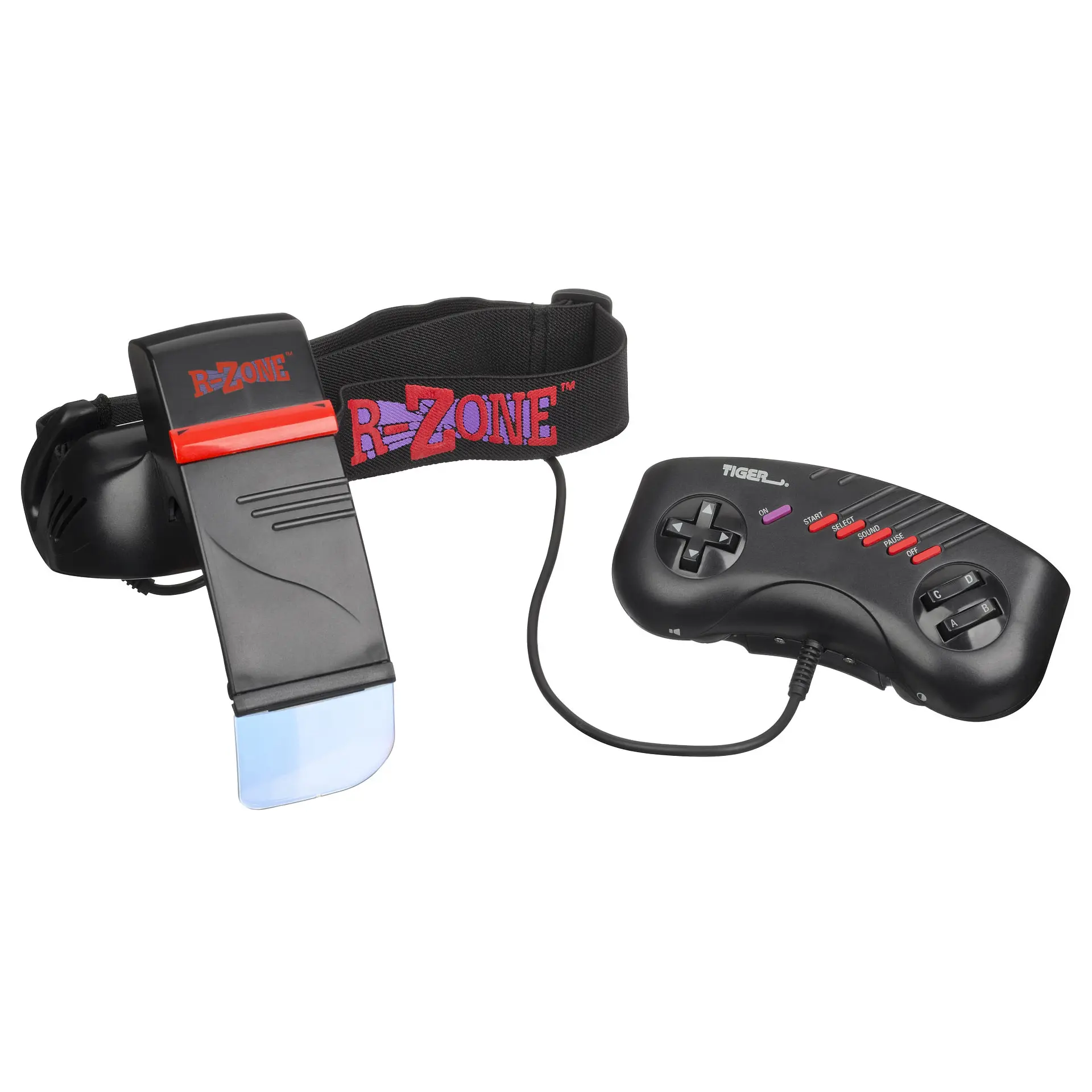
While Nintendo were working on their Virtual Boy, Tiger got the idea to market its newest console as a Virtual Reality handheld. To achieve such claim, they decided to project the game on a glass using a mirror and use the color red, the same color used by the Virtual Boy.
During that period, Tiger acquired the Texas Instruments toy division and agreed to manufacture and market electronic toys for Hasbro and Sega. The deal with Sega would also translate to more Sega licences being released on their future console.
The R-Zone was shown at the American International Toy Fair in February 1995 and was released just in time for Christmas of the same year.
Release
With the holidays just around the corner, Tiger launched an aggressive advertising campaign that was borderline misleading. The R-Zone was advertised as a virtual reality console, and customers were led to believe that the system was capable of producing 3D images. With next to no hands-on reviews available, the system did fairly well in the first Christmas season. The story changed drastically after the holidays, once children had the opportunity to try the device for the first time. Customers realized that there was no virtual reality or 3D imagery involved, and the HeadGear was causing headaches, dizziness and sore eyes, in addition to being rather uncomfortable and awkward to use.
Tiger reacted quickly and created a new version of its handheld called the R-Zone Super Screen in 1996. The new version introduced an additional feature called the “Super Screen”, which was basically an overlay that gave the games a color background. The R-Zone Super Screen also removed the mirror, which removed the constraint of looking at the device from a specific angle. Although the Super Screen was a major improvement over the HeadGear model, the device was still very bulky and didn’t generate a lot of attention. For a while, the two models were sold together, and cartridges were available with a “bonus” Super Screen background.
Tiger came up with a last version in 1997. The X.P.G. (which stands for Xtreme Pocket Game) is probably what Tiger should have released in the first place. The system now projects the game directly in a mirror, which makes it portable and comfortable. Sadly, this new approach meant that Tiger had to drop support for the Super Screen background, which was a great addition to the original design. The X.P.G. came way too late in the life of the device, as Tiger decided to abandon R-Zone development altogether.
Although it was not planned as a replacement for any model, there is also a fourth model called the DataZone, which is in fact a PDA that has the ability to play R-Zone cartridges. This version is the rarest of the four.
Demise
Ultimately, the R-Zone’s marketing was its own demise, as Tiger sold the handheld as a new, innovative device instead of an improved version of its LCD games. The R-Zone never stood a chance against the other handhelds of the time, but it could have done well on its own if Tiger had not tried to sell it as the hot new handheld of the time.
Consoles
 |
 |
 |
 |
||||
| HeadGear Late 1995 $29.99 |
Super Screen 1996 $29.99 |
X.P.G. 1997 |
DataZone Late 1996 |
Games
The R-Zone was such a commercial failure that little to no information exists on the exact number of games released. Games came in two formats, with or without the Super Screen. Again, there is no official information on which games had a Super Screen release, but we indicate the ones we have confirmed in the list below.
Confirmed
We have confirmed the existence of 27 games. Although some are common, some of them are extremely rare because they were produced in such small quantities. The Mask of Zorro and Football are confirmed to be region-exclusive, but others could be as well.
 |
 |
 |
 |
| Apollo 13 | Area 51 [Exist in Super Screen version] |
Batman & Robin | Batman Forever |
 |
 |
 |
 |
| Battle Arena Toshinden [Exist in Super Screen version] |
Daytona USA [Exist in Super Screen version] |
Football European Exclusive (France) |
Independence Day [Exist in Super Screen version] |
 |
 |
 |
 |
| Indy 500 | Judge Dredd | Jurassic Park: The Lost World | Men in Black |
 |
 |
 |
 |
| Mask of Zorro UK Exclusive, Only as a Pack-in |
Mortal Kombat 3 [Exist in Super Screen version] |
Mortal Kombat Trilogy | Nights into Dreams [Exist in Super Screen version] |
 |
 |
 |
 |
| Panzer Dragoon [Exist in Super Screen version] |
Primal Rage | Road Rash 3 [Exist in Super Screen version] |
Star Wars: Imperial Assault |
 |
|
 |
|
| Star Wars: Jedi Adventure | Star Wars: Millennium Falcon Challenge [Exist in Super Screen version] |
Star Wars: Rebel Forces | Virtua Cop |
 |
|
|
|
| Virtua Fighter | Virtua Fighter 2 | VR Troopers |
Rumored
Many lists on the Internet include these two games, but no proof of their existence was ever produced.
- Star Trek
- Waterworld
Unreleased
Finally, we have one game that was announced in 1995 before the release of the R-Zone and was never released.
- Spawn