|
|
|
History
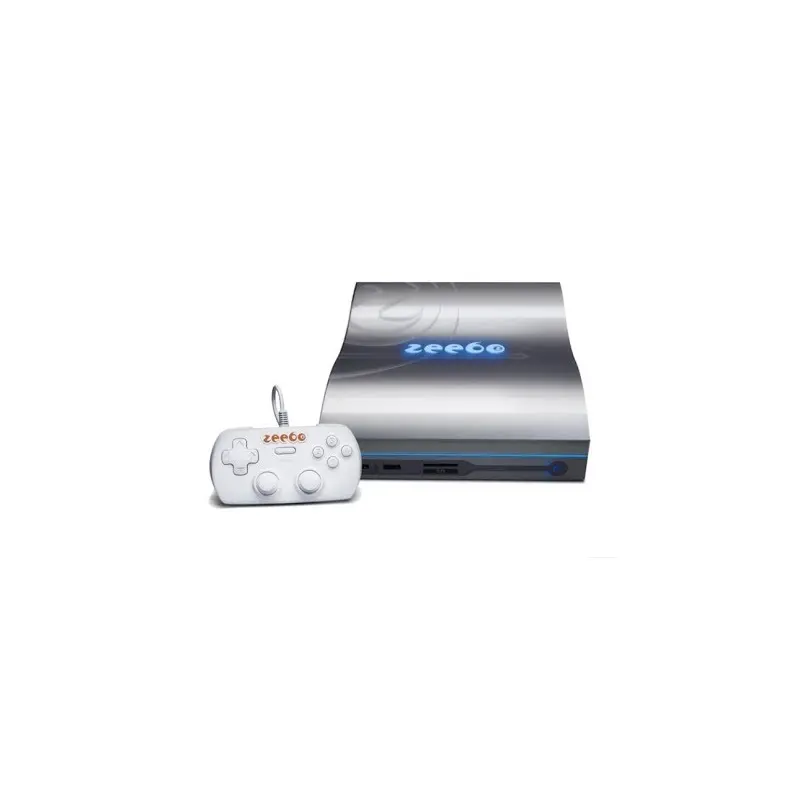
The idea behind the Zeebo was conceived by both Reinaldo Normand and Mike Yuen. Reinaldo Normand, who was working at Tectoy Mobile at the time, had an idea to develop an online-enabled video game console. While searching for backers for his project, Reinaldo met Mike Yuen, senior director of games and services at Qualcomm, who had a similar concept in mind. Qualcomm decided to fund the project and had Dave Durnil, Director of Engineering at Qualcomm, design and build the first working prototype of a 3G wireless gaming and entertainment console. At this point, Tectoy of America became Zeebo Inc., in March 2008. Normand joined the executive staff and was given responsibility for worldwide special projects. Dave Durnil became an engineering advisor for Zeebo Inc. Yuen left Qualcomm and was named Zeebo’s senior vice president of content and services in August 2009. He served as president and CEO.
The distinguishing feature of the console is the complete absence of media ports. All games must be downloaded through the online store. An optional keyboard would also expand the capabilities of the system.
Release
The company introduced the Zeebo in limited quantities in Rio de Janeiro, Brazil, on June 1, 2009, with manufacturing and distribution provided by Tectoy. The system went on sale nationwide in Brazil in November of the same year. During that time, the system had multiple price drops, from R$499 at launch to R$399 in September 2009 and R$299 by November 2009. In November 2009, the Zeebo also went on sale nationwide in Mexico and was planned to be sold in China. Zeebo Inc. announced an agreement with AT&T in March 2010, and in June 2010 it was reported that Zeebo Inc. had raised $13.5 million in its latest round of venture funding. On September 1, 2010, Zeebo announced a number of new games and educational applications to be launched in 2010 and 2011. Things were going well.
Demise
On May 27, 2011, Zeebo Inc. decided to drop its flagship console to work on a new Android-based platform with a 2012 launch date. The focus would now be interactive education for emerging markets around the world, with near-term operations and business interests centered on India. To this end, Zeebo also announced the end of its operations in Brazil and Mexico. According to the company, all games would undergo a price reduction, Zeebonet 3G would remain active until September 30, and all warranty services would be honored. The company finally closed its doors in 2014 without ever releasing its next console. At that time, its website was still showing a 2012 planned release date for the upcoming console.
Technical Specifications
- CPU: ARM11 / QDSP-5 running at 528 MHz, in the Qualcomm MSM7201A system-on-chip
- Graphics: Qualcomm Adreno 130 (ATI Imageon), up to 4 million triangles per second
- RAM: 160 MB (128 MB DDR SDRAM in MCP + 32 MB stacked DDR SDRAM in the MSM7201A)
- Storage: 1 GB eNAND flash plus 128 MB NAND flash in MCP, expandable through an SD card slot
- Video output: VGA, 640 × 480 resolution, 4:3 aspect ratio
- Audio: 8 simultaneous channels (MP3, ADPCM, MIDI)
- Connectivity: Built-in 3G modem (scaling back to 2.5G or 2G where necessary), no Wi-Fi
- Online service: ZeeboNet on Claro 3G (Brazil) and Telcel (Mexico)
- Ports: 3 × USB 2.0 Standard A (for accessories, such as the keyboard) and 1 SD card slot
- Operating system: Qualcomm BREW
- Media: None (all games are downloaded over 3G)
- Power: AC adapter, 5 V 3 A, 15 W maximum
- Dimensions: 157 × 215.4 × 44 mm
- Weight: 1.3 kg