|
|
|
History
Daewoo was founded in 1967 by Kim Woo-choong. At the time, the South Korean government had begun a series of five-year economic plans under which the country’s large family-owned business conglomerates (chaebols) were required to meet specific targets. As a newly established company, Daewoo did not become involved until the second of these plans, when it was able to take advantage of government loans for export goods in the clothing and textile industries. Over the following decade, Daewoo continued to support the national economic effort through successive five-year plans. While its primary focus remained on these government objectives, the company also expanded into other sectors and began producing various goods, including consumer electronics. In 1984, Daewoo released its first computer, the DPC-100.
Note: There is some information about a possible DPC-80 that may have been released prior to the DPC-100, but no concrete evidence has been found to confirm this.
The DPC-100 was based on the MSX1 standard, a standardized home-computer architecture introduced in 1983. The MSX standard quickly became very popular, especially in Japan, where many companies produced MSX-compatible machines. Because South Korea did not yet have copyright legislation protecting computer software, numerous computer-store chains—such as Zemina, Prosoft, Clover, Topia, Screen Software, and Aproman—began producing bootleg copies of Japanese titles. These companies went so far as to add their own copyright notices to the games, presenting them as if they had developed the software themselves.
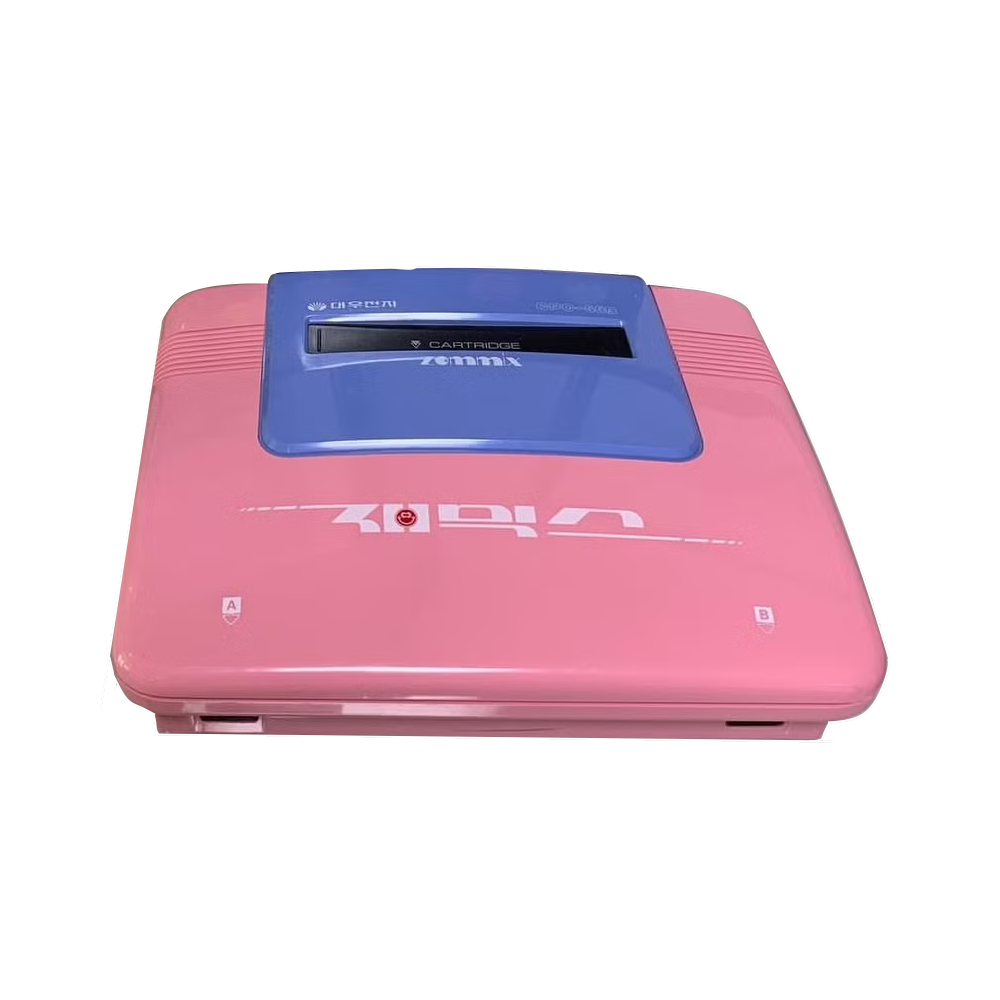
In 1985 Daewoo launched the first MSX-based video game console: the Zemmix (CPC-50). The name means “It’s Fun” in Korean. It was essentially an MSX1 computer redesigned as a cartridge-only console and sold exclusively in South Korea.
Release
The original Zemmix was released in 1985 at ₩70,000 (or ₩81,000 with a joystick). It was significantly cheaper than Daewoo’s own DPC-100 computer (₩257,000) and was well received.
The first model (CPC-50) had only 8 KB of RAM and 16 KB of VRAM. While early MSX games ran adequately, more complex titles struggled. Daewoo therefore released two successive revisions:
- CPC-50A (1986) – new CPU and minor internal changes
- CPC-50B (1987) – memory upgraded to 64 KB of RAM (still 16 KB of VRAM)
The console was offered in several colour combinations, most commonly pink/white or green/white on the earlier models. It came with a large external power supply that included the power switch, one joystick, and a multi-game cartridge.
Because the machine lacked a keyboard, the official MSX logo was not present. It is therefore sometimes described as a “hidden MSX.”
Demise
The limited memory of the early models created problems. Although corrected in CPC–50B revision, the harm was already done and the Zemmix got the reputation of not being able to run all the games. The second problem concerned the 20-in-1 cartridge bundled with the console. On 1 July 1987 the Law for the Protection of Computer Programs (Bill No. 3920) came into effect. This legislation prohibited the sale and distribution of pirated software. Because the included cartridge lacked the proper licences, it became a legal problem for Daewoo to continue distributing it.
In order to tackle these challenges, Daewoo replaced the original Zemmix with a completely redesigned model, the Zemmix V (CPC-51) in 1988. The new machine kept the same improved hardware as the final CPC-50B but featured a distinctive new case and no pack-in game, solving the licensing issue while refreshing the product line.
Technical Specifications
- CPU: Zilog Z80A (Goldstar) @ 3.58 MHz (CPC-50)
- RAM: 8 KB (later increased to 64 KB on the CPC-50B)
- VRAM: 16 KB
- Video: Texas Instruments TMS9918A (MSX1 standard)
- Sound: AY-3-8910A PSG (3 channels + noise)
- Media: ROM cartridges (MSX1 compatible)
- Controllers: 2 × joystick ports
- Video output: RF + composite
- Power: External AC adaptor (different versions for each revision)