|
|
|
History
Daewoo was founded in 1967 by Kim Woo-choong. At the time, the South Korean government had begun a series of five-year economic plans under which the country’s large family-owned business conglomerates (chaebols) were required to meet specific targets. As a newly established company, Daewoo did not become involved until the second of these plans, when it was able to take advantage of government loans for export goods in the clothing and textile industries. Over the following decade, Daewoo continued to support the national economic effort through successive five-year plans. While its primary focus remained on these government objectives, the company also expanded into other sectors and began producing various goods, including consumer electronics. In 1984, Daewoo released its first computer, the DPC-100 based on the MSX1 standard, a standardized home-computer architecture introduced in 1983. The MSX standard quickly became very popular, especially in Japan, where many companies produced MSX-compatible machines. Because South Korea did not yet have copyright legislation protecting computer software, numerous computer-store chains—such as Zemina, Prosoft, Clover, Topia, Screen Software, and Aproman—began producing bootleg copies of Japanese titles. These companies went so far as to add their own copyright notices to the games, presenting them as if they had developed the software themselves. This sudden abundance of MSX software created an opportunity for Daewoo, which in 1985 introduced the first MSX-based video-game console: the Zemmix, followed by the Zemmix V.
A law introduced in 1987 called the Law for the Protection of Computer Programs had reduced the supply of unlicensed MSX software, while official Japanese and American consoles began arriving in Korea. In 1989 Samsung released the Sega Master System as the Gam*Boy, and Hyundai launched the Nintendo Entertainment System as the Comboy. These more modern 8-bit systems put pressure on Daewoo’s ageing MSX1 hardware. To remain competitive, Daewoo developed a true MSX2 console: the Zemmix Super V (CPC-61).
Official 8-bit and emerging 16-bit consoles continued to gain ground, and the broader MSX platform was already in decline outside of niche circles. Daewoo made one final attempt to modernise the line with the MSX2+-compatible Zemmix Turbo (CPG-120) in 1991.
Release
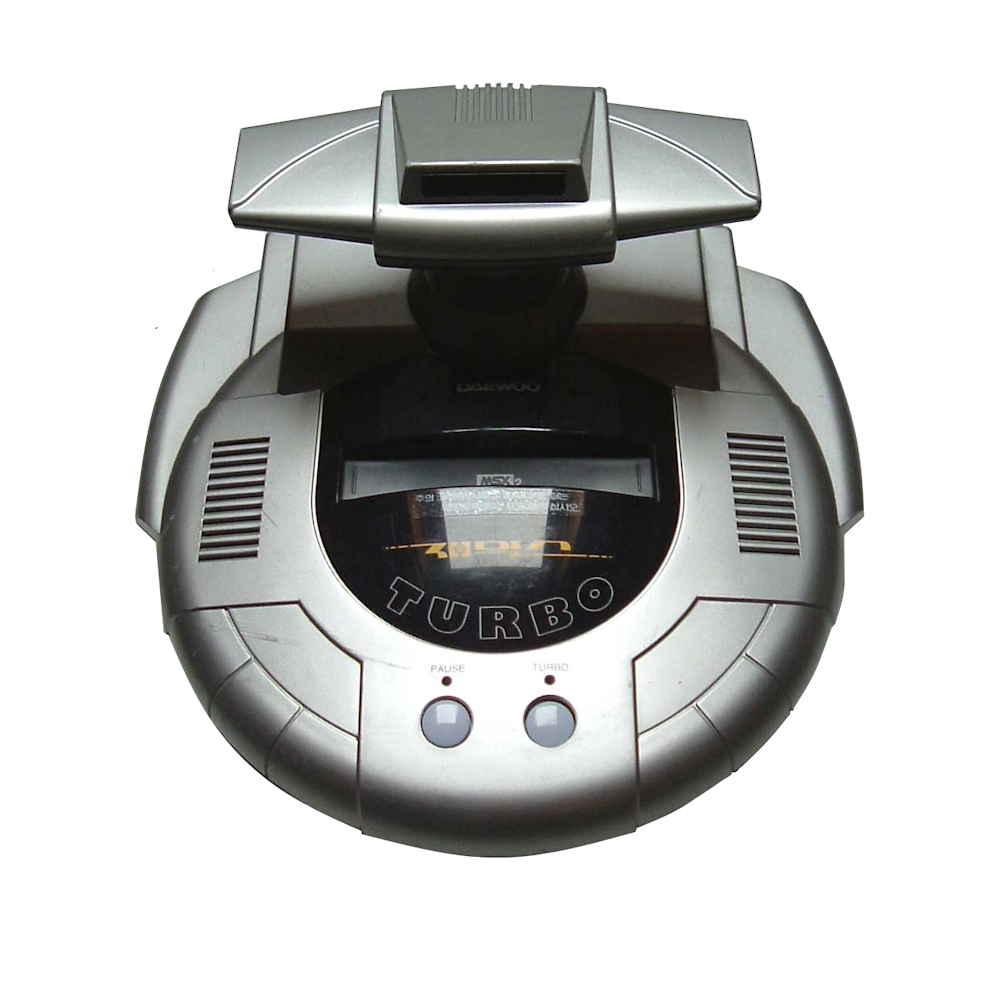
The Zemmix Turbo arrived with a striking futuristic “space-fiction” design that remains one of the most unusual in the entire MSX family. It featured a prominent equalizer-style display on the front panel, dedicated Turbo and Pause buttons, and a more refined build than earlier models.
Key hardware upgrades included:
- Yamaha V9958 video display processor (the same chip used in MSX2+ computers)
- 64 KB of main RAM (some sources suggest configurations up to 128 KB)
- 128 KB of VRAM
- Full MSX2 compatibility with partial MSX2+ support (the machine uses the V9958 but retains an MSX2-level BIOS/BASIC, so not every MSX2+ program detects it correctly)
A hardware Turbo button allowed the Z80A CPU to be overclocked from the standard 3.58 MHz to approximately 5.37 MHz (a 50 % increase). The console also included Hangul BASIC, came bundled with a CPJ-905S joystick and a 30-in-1 game cartridge, and offered a connector for an optional keyboard.
Demise
Despite its advanced specifications and distinctive design, the Zemmix Turbo arrived too late. By 1991 the broader MSX platform was already in steep decline, and the Korean market was increasingly dominated by more modern 16-bit systems. The CPG-120 became the final official Daewoo Zemmix model. Production of the entire Zemmix line ended around 1995.
Today the Zemmix Turbo is highly sought after by collectors for its unique appearance and status as the most powerful console in the original Zemmix series.
Technical Specifications
- CPU: Zilog Z80A (Goldstar) @ 3.58 MHz (overclockable to ~5.37 MHz via Turbo button)
- RAM: 64 KB (slot 0-2)
- VRAM: 128 KB
- Video: Yamaha V9958 (MSX2+ VDP)
- Sound: AY-3-8910A PSG (3 channels + noise); some units also include YM2413 FM support
- Chipset: Custom Daewoo DW64MX1
- Media: ROM cartridges (MSX1 / MSX2 / partial MSX2+ compatible)
- Controllers: 2 × joystick ports + optional keyboard connector
- Extras: Turbo button, Pause button, front-panel equalizer display, Hangul BASIC
- Video output: RF, composite, analog audio
- Power: External AC adaptor