|
|
|
History
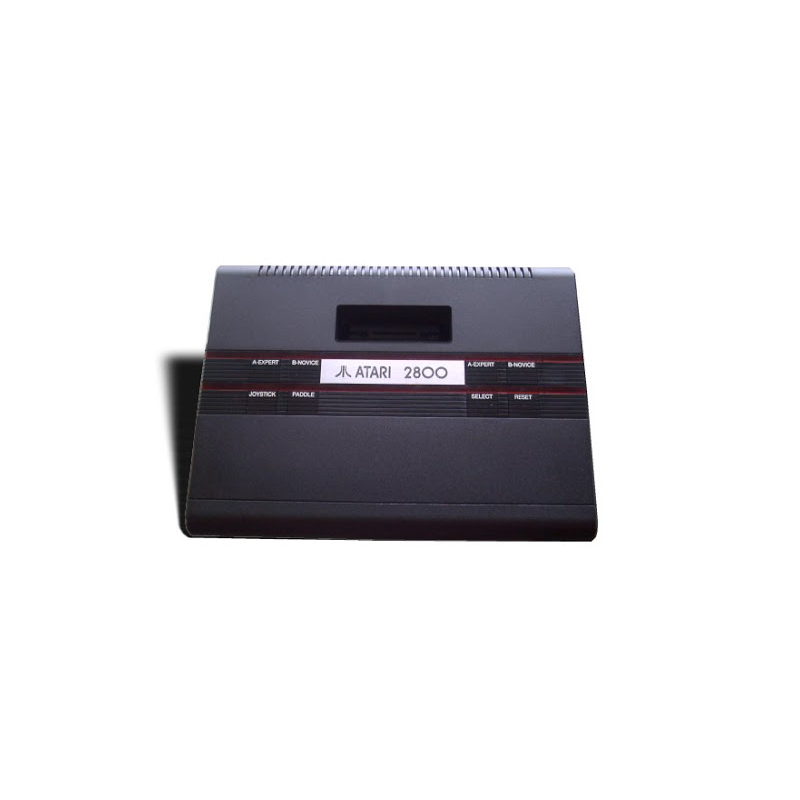
The story of the Atari 2800 begins in the late 1970s. At that time, while the video game industry was booming in North America, it was not the case in Japan. Japan had yet to become a force in the video game industry and was, for the most part, merely copying concepts that had had some success in the West. This was mostly because non-Japanese companies had a hard time selling their products in Japan. Even though the name Atari does exist in Japanese (当たり, meaning “hit”, “strike” or “to be right”), the brand was unknown and needed to be sold under a Japanese brand to have a chance of being successful.
In 1979, Epoch, one of the leading Japanese video game developers of the time, entered into a partnership with Atari and released two products on the Japanese market. The first was the TV Block, a redesign of the Atari Video Pinball C-380. The company then released, in October 1979, a rebranded version of the Atari VCS (2600) under the name Epoch Cassette TV Game. At a steep price of ¥57,300, the console was not a success. As Space Invaders was really popular in Japan, Epoch asked Atari to create a version for the 2600 to try to boost sales, but even with the release of Space Invaders on the VCS, the Cassette TV Game was not able to break into the market. Eventually, Epoch stopped selling the Epoch Cassette TV Game and instead sold its own console: the Cassette Vision.
Meanwhile, in North America, Atari was working on a redesigned version of the 2600. Under the supervision of engineer Joe Tilly, the new design would be much more modern, with a minimalist look. The console would have four controller ports instead of the standard two on the Atari 2600. The controllers were also redesigned by John Amber and served as both an 8-direction digital joystick and a 270-degree paddle.
Sadly, by the time Atari was ready to release its new design in North America, the North American video game crash had just started, and the demand for new systems was winding down rapidly. Atari decided to release the 2800 in one of the only major video game markets where it didn’t have a presence yet: Japan.
Release
Sadly for Atari, its release window was in the midst of the Japanese Console War. While the Atari 2800 had a very strong lineup and a bit of brand recognition thanks to the units previously imported by Epoch, it had little to no incentive over the powerful Nintendo Famicom.
Demise
The fate of the Atari 2800 was quickly decided, and the console fell into obscurity, at least in Japan. Sears released the same model under the brand Sears Video Arcade II in North America. The case design was later used by Barney Huang to design the Atari 7800.
After Warner Bros. sold Atari’s home division to former Commodore CEO Jack Tramiel in 1984, Atari went on to release both the Atari 7800 and a lower-cost version of the 2600, called the Atari 2600 Jr. While the 2800 was certainly an option, it was not as cheap to produce, so Tramiel opted for the most cost-effective solution instead. After 1986, no other revision of the 2600 was produced by Atari, which killed any chance of bringing an Atari-branded 2800 to North America.
Games
Although the 2800 is fully compatible with all Atari 2600 games, around 30 games were specifically released for it in Japan. The folks at www.freelancer-games.com have a very interesting article on the subject, with a list of every game released for the system.A
Technical Specifications
- Media: Cartridge (fully compatible with Atari 2600 cartridges)
- CPU: MOS Technology 6507, 8-bit, running at 1.19 MHz (a cut-down 6502 with an 8 KB address space)
- Video, audio and input: TIA 1A (Television Interface Adaptor, Model 1A)
- Memory and I/O: PIA 6532 (128 bytes of RAM, I/O ports and a timer)
- Controller ports: 4 standard 9-pin ports on the front, with clips that keep the controllers from being pulled out. It used one paddle per port, instead of two sharing the same port as on the 2600.
- Controllers: All-in-one design combining an 8-direction digital joystick and a 270-degree paddle
- Switches: Power, black/white, left difficulty, right difficulty, game select and reset
- Output: RF
- Codename: “Cindy”
- Original price: ¥24,800
- Release: October 1983 in Japan