|
|
|
History
Nintendo was founded on September 23, 1889, in Kyoto by Fusajiro Yamauchi as Nintendo Koppai (later Yamauchi Nintendo). The company began as a manufacturer of handmade hanafuda (flower cards), traditional Japanese playing cards. For decades Nintendo remained primarily a card and toy company, expanding into Western-style playing cards and, by the mid-20th century, a wide range of toys and gadgets.
Under the leadership of Hiroshi Yamauchi (who took control in 1949), Nintendo diversified aggressively. In the late 1960s and early 1970s the company produced innovative toys such as the Ultra Hand, Ultra Machine, and a series of light-gun toys known as the Beam Gun series. These optical light-gun toys placed Nintendo among the early developers of electronic shooting games. Around the same period, Magnavox released the Odyssey (1972), whose light-gun/rifle accessory used similar photoelectric technology. Nintendo’s prior experience with light-gun toys and optical sensors gave the company valuable expertise that would later influence its own light-gun peripherals (most notably the Famicom/NES Zapper).
In the mid-1970s Nintendo entered the electronic entertainment market more directly. It released the Color TV-Game series of dedicated home consoles beginning in 1977. In 1980, Gunpei Yokoi’s team launched the Game & Watch line of handheld LCD games, which became a major commercial success and helped fund further video-game development. The real breakthrough came in the arcade sector. After mixed results with early titles, Nintendo released Donkey Kong in 1981, designed by a young Shigeru Miyamoto. The game was a massive international hit, introduced the character who would become Mario, and established Nintendo as a serious force in the video-game industry.
By 1983 Nintendo was ready to enter the home console market with a fully programmable, cartridge-based system designed by Masayuki Uemura’s team.
Release
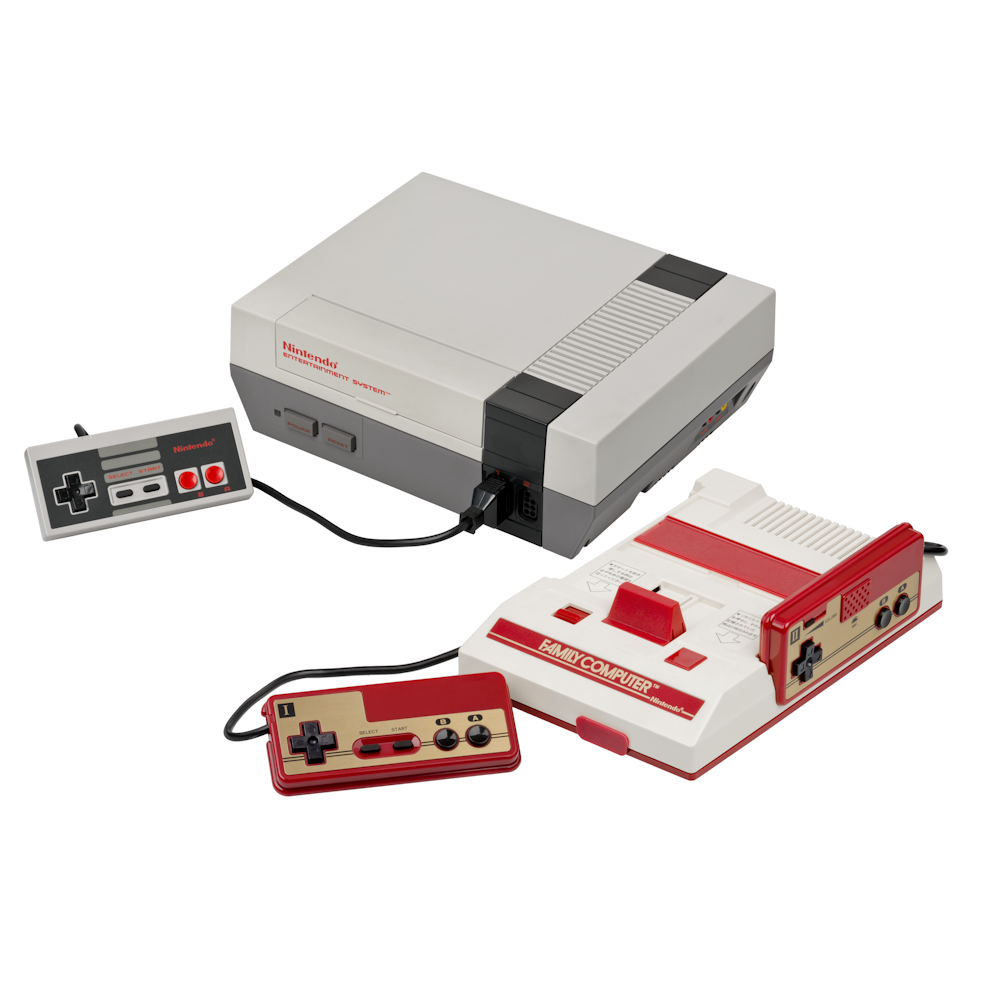
The Family Computer was released in Japan on July 15, 1983, at a price of ¥14,800. It launched with three games: Donkey Kong, Donkey Kong Jr., and Popeye. The system featured hardwired controllers (one with a microphone), a distinctive red-and-white design, and a 60-pin cartridge slot. Although the Famicom was released on the same day as the Sega SG-1000 and in the same year as 5 other video games console (see the The Japanese Console War article), it quickly dominated the Japanese market.
Although Japanese players immediately began shortening “Family Computer” to “Famicom,” Nintendo could not officially use that name at launch. In 1979 Sharp had released a Family Convection Oven marketed as the “Famicon” (ファミコン) and later secured trademarks for the term that covered consumer electronic devices. Because the pronunciation was identical and the classification was broad, Nintendo was blocked from registering “Famicom” for its console and was forced to use the full name “Family Computer.” The two companies eventually reached an amicable agreement: Sharp transferred the trademark to Nintendo on 17 October 1985, and in return Nintendo licensed the Family Computer hardware to Sharp. This partnership produced several Sharp-branded Famicom variants, including the C1 Famicom TV (a television with a built-in Famicom), the Twin Famicom (a combined Famicom and Disk System unit release in 1986), and the Famicom Titler, a Family Computer system with built-in video titling and genlock hardware, also release in 1986.
Sharp would also release their own version of the FamicomBox called the Famicom Station – a multi-cartridge unit designed primarily for hotels and commercial use.
Nintendo initially sought a partner to distribute the Famicom outside Japan. In 1983 the company nearly reached an agreement with Atari under which Atari would manufacture and sell the system (internally referred to as the “Atari 3600” or similar) worldwide except Japan. The deal progressed through detailed negotiations, including minimum purchase commitments and plans for Atari to convert several of its arcade titles. However, the agreement collapsed after a public dispute at the 1983 Consumer Electronics Show involving Coleco’s demonstration of a Donkey Kong port on the ADAM computer (Atari held certain computer rights to the game). Internal turmoil at Atari, including the departure of key executives, further doomed the partnership. Nintendo was forced to enter the North American market on its own.
By the time Nintendo prepared its U.S. launch, the North American video-game industry had collapsed in the 1983 crash. Retailers were deeply wary of video-game consoles. Nintendo responded by rebranding the system as the Nintendo Entertainment System (NES) and deliberately marketing it as a home entertainment product rather than a traditional video-game console. The package emphasized accessories such as the Robotic Operating Buddy (R.O.B.) and the Zapper light gun, positioning the system as a versatile toy/entertainment device. It was sold primarily through toy departments rather than the discredited electronics or video-game sections.
A critical element of Nintendo’s strategy was strict control over software. The company introduced the Official Nintendo Seal of Quality and a licensing system that required all third-party publishers to obtain Nintendo’s approval. This prevented the flood of low-quality games that had contributed to the 1983 crash and ensured a consistent level of quality on the platform. Combined with strong first-party titles and careful retail relationships, the approach allowed the NES to revive and then dominate the North American market after its limited 1985 test launch and full 1986 rollout.
To enforce this control on the NES, Nintendo incorporated a security system known as the 10NES (or CIC – Checking Integrated Circuit). A matching pair of chips—one in the console and one in the cartridge—had to exchange a specific authentication sequence at power-on. If the handshake failed, the console entered a continuous reset loop and refused to run the game. This effectively blocked unlicensed software.
Several companies found ways to bypass the lockout. Some used voltage spikes to temporarily disable the console’s chip; others employed piggyback adapters that passed the signal from a licensed cartridge. The most prominent challenge came from Tengen, the NES division of Atari Games. After failing to fully reverse-engineer the 10NES through conventional means, Tengen obtained a copy of the chip’s source code from the U.S. Copyright Office by falsely claiming it was needed for ongoing litigation. Using this information, Tengen developed its own compatible chip (the “Rabbit”) and began releasing unlicensed games in distinctive black cartridges.
Nintendo responded with lawsuits. Tengen countersued, alleging antitrust violations and arguing that reverse engineering should be protected as fair use. In the resulting litigation (Atari Games Corp. v. Nintendo of America Inc.), the courts ultimately sided with Nintendo on key copyright-infringement claims, particularly because of the improper manner in which Tengen had obtained the source code. By the early 1990s Nintendo had largely prevailed, and Tengen’s unlicensed NES activities were curtailed. Despite these legal battles, a number of unlicensed games—both from Tengen and from other publishers—still reached the market and remain part of the system’s collector history today.
Demise
The Famicom/NES remained commercially viable well into the early 1990s. In Japan the Famicom was eventually succeeded by the Super Famicom (1990). In North America the NES continued to sell strongly until the Super Nintendo Entertainment System took over. Worldwide lifetime sales reached approximately 61.91 million units, making it one of the best-selling consoles of all time and the system that re-established the home video-game industry after the 1983 crash.
Games
The Famicom and NES together received more than 1,300 officially licensed titles during their commercial lifespans (with over 1,000 released in Japan alone and several hundred in North America and Europe). Nintendo maintained tight control over the library through its licensing program and the Official Nintendo Seal of Quality, requiring third-party publishers to obtain approval and, outside Japan, to have Nintendo manufacture the cartridges.
Technical Specifications
- CPU: Ricoh RP2A03 (NTSC) / RP2A07 (PAL) — modified 8-bit MOS 6502 core with integrated audio processing unit (APU)
- Clock speed: approximately 1.79 MHz (NTSC) / 1.66 MHz (PAL)
- PPU (Picture Processing Unit): Ricoh RP2C02 (NTSC) / RP2C07 (PAL)
- Memory:
- 2 KB work RAM
- 2 KB video RAM (VRAM)
- 256 bytes Object Attribute Memory (OAM) for sprites
- Cartridge ROM expandable via bank-switching mappers (typical cartridge sizes 8–512 KB or more)
- Display:
- Resolution: 256 × 240 pixels (effective visible area often ~256 × 224 due to overscan)
- 64-entry color palette; up to 25 colors on screen simultaneously
- Up to 64 sprites (8 × 8 or 8 × 16 pixels), maximum 8 sprites per scanline
- Sound: 5 channels generated by the CPU/APU
- 2 pulse-wave channels
- 1 triangle-wave channel
- 1 noise channel
- 1 DPCM (delta modulation) channel
- Famicom cartridges support additional expansion audio via extra pins
- Controllers:
- Famicom: two hardwired controllers (Player 2 includes a microphone)
- NES: two detachable controllers with 7-pin connectors
- Media: 60-pin ROM cartridges (Famicom) / 72-pin ROM cartridges (NES)
- Output: RF (Famicom and original NES); later models and Sharp variants offered composite or improved video options
- Power: Famicom uses a 10 V DC adapter; NES uses a 9 V AC adapter