|
|
|
History
Sharp Corporation traces its origins to September 15, 1912, when 19-year-old Tokuji Hayakawa opened a small metalworking shop in Tokyo. His first major invention was the Tokubijo snap buckle, a belt fastener that required no holes. In 1915 he developed the Hayakawa Mechanical Pencil (later marketed as the Ever-Ready Sharp Pencil), which gave the company its lasting name. After the Great Kantō Earthquake of 1923 destroyed his Tokyo operations, Hayakawa relocated to Osaka and rebuilt. In 1925 the company produced Japan’s first crystal radio set and grew into a major radio manufacturer. Over the following decades Sharp expanded into televisions, calculators, and a wide range of consumer electronics, formally adopting the name Sharp Corporation in 1970.
Sharp’s earlier involvement with Nintendo hardware included limited production of Color TV-Game units. Nintendo’s Color TV-Game series (starting with the Color TV-Game 6 in 1977) were dedicated Pong-style consoles. Sharp manufactured special versions of these systems, including dark-orange Color TV-Game 6 units intended for bundling with Sharp televisions and a white Color TV-Game 15 variant sold as the Color TV-Game XG-115.
By the late 1970s Sharp was a leading Japanese electronics firm. In 1979 it released a convection oven marketed as the Family Convection Oven, commonly abbreviated “Famicon” (ファミコン). Sharp registered the trademark for the term under the broad category of consumer electronic devices. When Nintendo prepared to launch its Family Computer in 1983, the company discovered it could not officially use the shortened name “Famicom” because of Sharp’s existing registration. Nintendo was forced to market the system under the full name “Family Computer,” even though the public immediately adopted “Famicom.”
The two companies eventually reached an amicable settlement. On October 17, 1985, Sharp transferred the “Famicom” trademark to Nintendo. In exchange, Nintendo licensed Family Computer hardware technology to Sharp, allowing the electronics maker to produce its own Famicom-compatible products. This agreement formalized a working relationship that had already begun to take shape.
With the trademark issue resolved and a formal license in hand, Sharp began releasing its own Famicom-based products. The first major collaboration was the C1 (also known as the My Computer TV or Sharp Nintendo Television), a CRT television with a built-in Famicom released in 1983. This was followed in 1986 by the Twin Famicom, an all-in-one unit that combined a Famicom and a Famicom Disk System in a single chassis.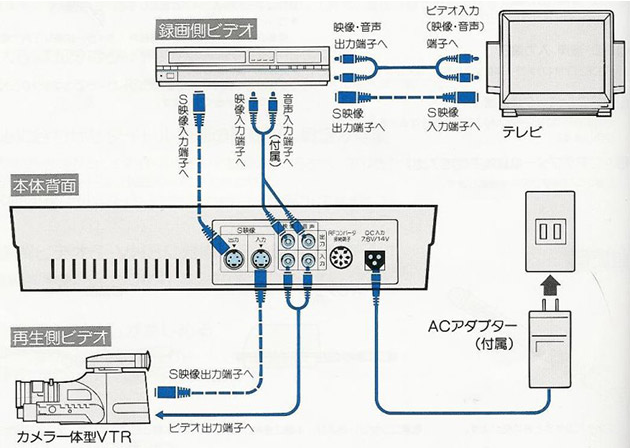
While Sharp previous releases were aimed at the general population, their next one would be a little more niche.
Release
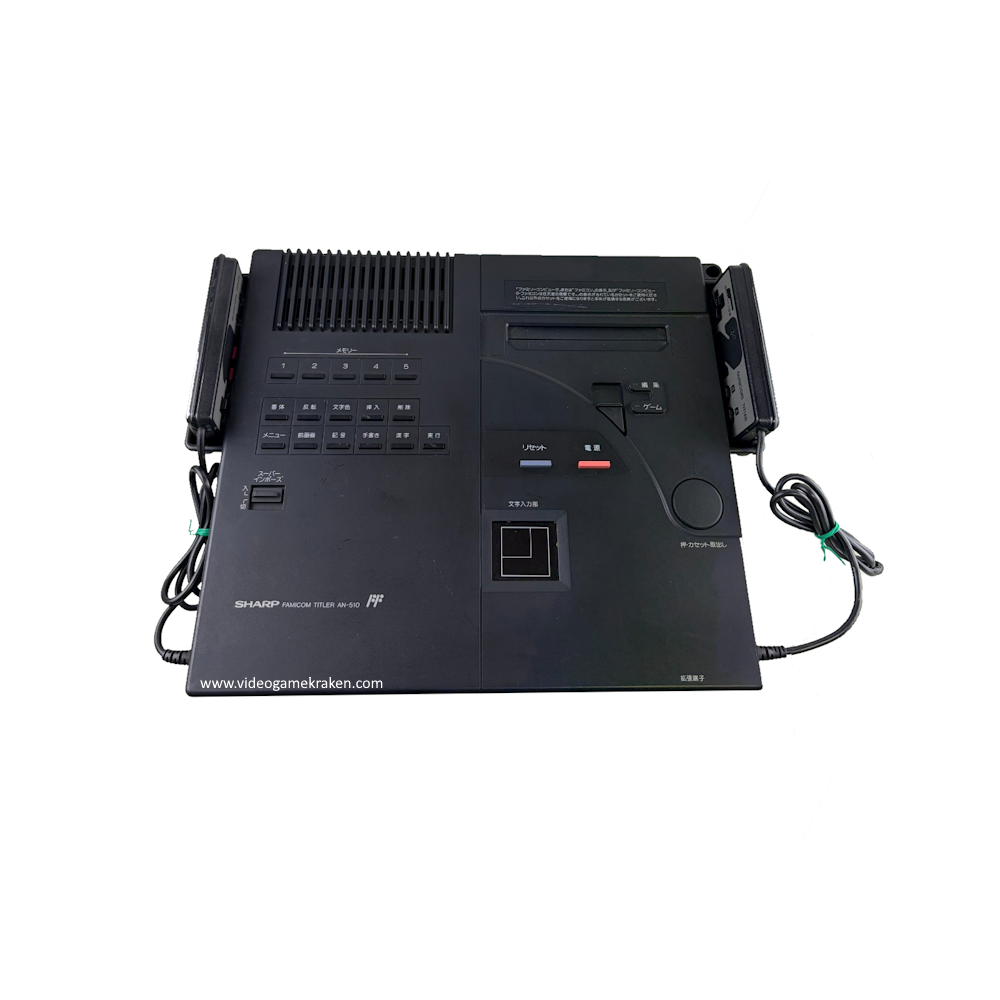
The Famicom Titler, launched in 1989, represented the most specialized of these licensed Sharp products. Building on the technical and commercial relationship established through the earlier collaborations, Sharp designed a Famicom-compatible console aimed at the emerging home-video market. The Titler combined standard Famicom gameplay with video-titling (also called character generation or CG —the process of adding text, titles, captions, or simple graphics on top of a video signal), genlock (short for generator locking — a technique that synchronizes one video signal to another so they can be mixed or overlaid cleanly), and overlay functions, using an RGB-capable PPU and S-Video output that set it apart from every other consumer Famicom of the era.
The Famicom Titler launched in Japan on February 21, 1989 at a suggested retail price of ¥43,000 — significantly more expensive than a standard Famicom or even the Twin Famicom. It was sold exclusively in Japan and never received an overseas release.
The unit is noticeably larger than a regular Famicom. It features a top-loading cartridge slot, two hardwired controllers styled like those of the Twin Famicom, a small pressure-sensitive touchpad with stylus, a set of function buttons/keyboard, a microphone input (via the second controller), and a mode switch that toggles between normal Famicom operation and the built-in video-editing software.
The Titler’s primary selling point was its video capabilities. It is the only consumer Famicom to generate RGB internally (using a special PPU, the RC2C05-99 / RP2C05-99) and the only official Famicom variant with native S-Video output. Composite and RF outputs are also present. This combination produced a noticeably cleaner image than standard RF or composite Famicoms of the era.
Demise
While previous Sharp release had a wider target audience, the Famicom Titler was very niche.Sharp aimed it at Japanese families and home-video enthusiasts in the late 1980s who already owned (or planned to own) a camcorder and VCR. Typical use cases mentioned in the manual and marketing included:
- Making personalized greeting or invitation videos for parties and celebrations
- Adding captions to recordings of children’s sports days, school events, or family gatherings
- Creating simple demo or gameplay videos with titles
- Producing home movies with on-screen messages for birthdays, weddings, or seasonal events
A common misconception is that the Titler was made for journalist. It was not aimed at professional video editors or broadcasters. The editing features were deliberately basic and template-driven.
At ¥43,000 it was also significantly more expensive than a regular Famicom, so it targeted households that already had disposable income for home electronics and were interested in the novelty of combining gaming with home-video production. Because of this, the Titler never sold in large number.
Features
In editing mode (activated by the front switch with no cartridge inserted, or via the built-in software), the system could:
- Overlay text and simple graphics onto an external video signal
- Superimpose Famicom gameplay over external video
- Add pre-made seasonal and event templates (festivals, Christmas, sports days, weddings, birthdays, children’s growth records, etc.)
- Accept handwritten input via the touchpad and stylus
- Record narration through the microphone
A battery-backed memory allowed users to save title setups. The system was intended for creating simple home-video demos, greeting messages, or gameplay footage with captions — essentially a consumer-level genlock and character generator built around a Famicom.
Technical Notes
- CPU: Ricoh RP2A03 (standard Famicom CPU)
- PPU: RC2C05-99 (RGB-capable variant)
- Work RAM: 2 KB + battery backup for editor data
- Controllers: Two hardwired units (Player 2 includes microphone)
- Video outputs: S-Video, composite, RF
- External video input for overlay/genlock functions
Because of the RGB PPU and S-Video path, the Titler remains highly regarded by collectors who want clean original-hardware Famicom video on modern displays without extensive modification. The editing functions, while basic by today’s standards, were unusual for a 1989 home console and give the machine a distinctive place among Sharp’s Nintendo-licensed products.