|
|
|
History
The story of the Sega Mark III does not begin in Japan, nor even in video games. In 1940, three American businessmen, Martin Bromley, Irving Bromberg and James Humpert, formed a company called Standard Games in Honolulu, Hawaii. Their business was simple: place coin-operated amusement machines, mostly slot machines and jukeboxes, on the military bases that were filling up with American servicemen. After the war, the partners wound down Standard Games and set up a new company named Service Games, a name that nodded to its military clientele.
The company soon moved its operations to Japan, and in May 1952 “Service Games of Japan” was registered. It is from this name that Sega takes its own: SErvice GAmes. The early years were not smooth. Service Games ran into trouble with authorities over alleged bribery and tax evasion, and between 1959 and 1960 it was banned from US air bases in Japan and the Philippines, which were its main customers. On May 31, 1960, Service Games of Japan was formally dissolved. A few days later, on June 3, 1960, a successor company called Nihon Goraku Bussan (“Japan Entertainment Products”) was founded, and it took over the assets of its predecessor.
Meanwhile, a second American in Tokyo was building a very different business. In 1954, David Rosen moved to Japan and founded Rosen Enterprises, originally to export Japanese art. When Rosen imported coin-operated instant photo booths, they became a surprise hit with the Japanese public, and the company expanded into importing coin-operated electro-mechanical games. In 1965, Nihon Goraku Bussan acquired Rosen Enterprises, and the merged company became Sega Enterprises, Ltd. Rosen took the lead of the new company. A year later, Sega released Periscope, a submarine-simulation game that became a worldwide arcade hit.
In 1969, Sega was sold to the American conglomerate Gulf+Western, although Rosen stayed on as head of the Sega division. In 1974, Gulf+Western made Sega a subsidiary of a newly created American company, Sega Enterprises, Inc. In 1979, Sega acquired Esco Boueki (Esco Trading), an arcade distribution company founded and owned by a Japanese businessman named Hayao Nakayama. That acquisition would prove to be one of the most important of the company’s history, because Nakayama would soon become its leader.
By the early 1980s, Sega was one of the top five arcade game manufacturers active in the United States, and its revenues had climbed to $214 million. Then came the arcade downturn of 1982. Hit hard, Gulf+Western sold Sega’s North American arcade manufacturing business and the licensing rights to its arcade games to Bally Manufacturing in September 1983, keeping only the North American R&D operation and the Japanese subsidiary, Sega Enterprises, Ltd. Nakayama, by then president of the Japanese company, argued that Sega should use its hardware expertise to enter the home console market in Japan, which was still in its infancy.
The result was the SG-1000, released on July 15, 1983. By a famous coincidence, Nintendo launched its Family Computer (Famicom) in Japan on exactly the same day. The comparison was unkind to Sega. The SG-1000’s three launch games were ports of arcade titles that lacked the name recognition of the Famicom’s launch lineup, which included Donkey Kong, Donkey Kong Jr. and Popeye. The SG-1000 sold only about 160,000 units in its first year. A cosmetically revised SG-1000 II followed in July 1984 but did little to change the situation.
Sega’s corporate situation was also changing. Shortly after the SG-1000’s launch, Gulf+Western’s chairman Charles Bluhdorn died, and the new management began to sell off the company’s non-core businesses. Nakayama and Rosen arranged a management buyout of the Japanese subsidiary in 1984, backed by CSK Corporation, a prominent Japanese software company. Nakayama became CEO of the new Sega Enterprises, Ltd., Rosen headed the American subsidiary, and CSK’s chairman, Isao Okawa, became chairman of Sega. Now independent from its American parent and unwilling to give up on the home market, Sega needed a console that could genuinely compete with Nintendo. It would be called the Mark III.
Release
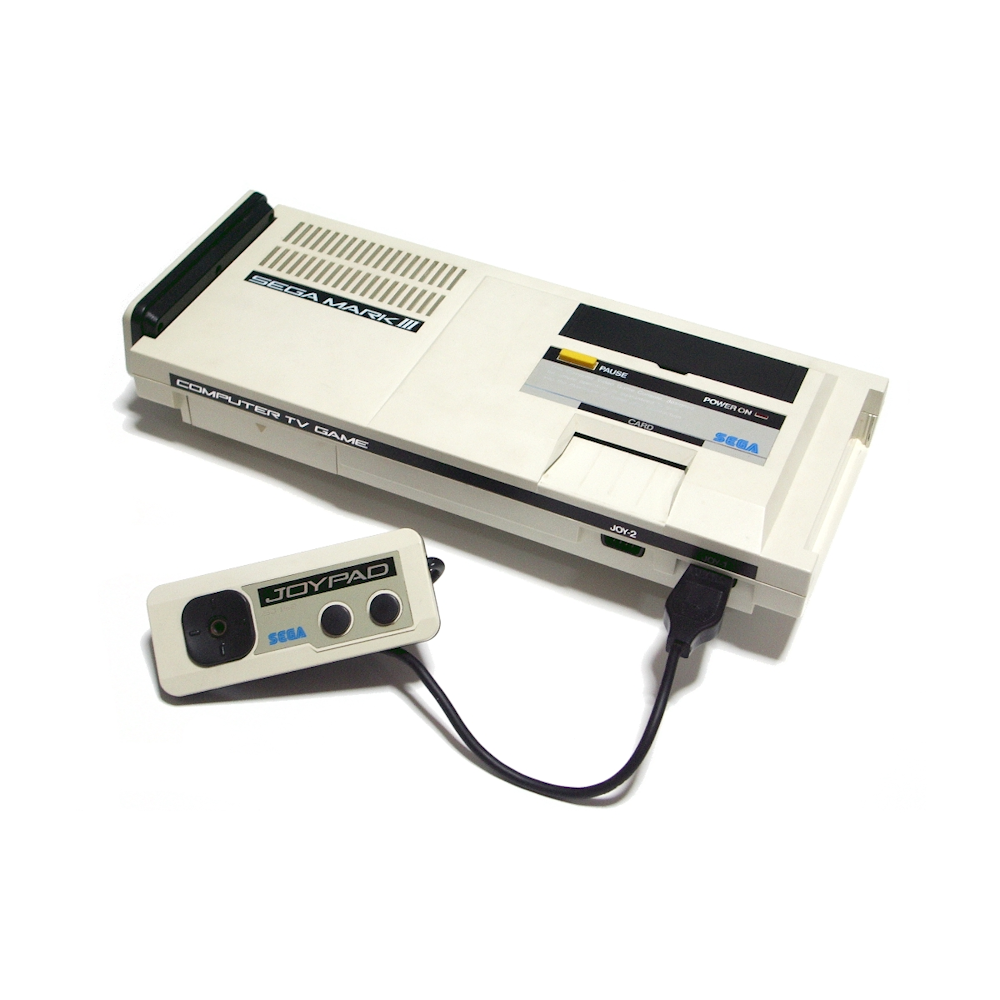
The Sega Mark III was released in Japan on October 20, 1985, about 15 months after the SG-1000 II , at a price of ¥15,000. Unlike the SG-1000 II , which was only a cosmetic refresh, the Mark III was a new system. It was built similarly to its predecessors but added a new video chip and more RAM. The video chip was designed in-house and was based on the unit used in Sega’s System 2 arcade board. Sega’s hardware chief, Hideki Sato, who had joined the company in 1971 when it was still mostly selling jukeboxes, has explained that the console was designed so that Sega’s System 1 and System 2 arcade games could be ported to it easily. This was the beginning of a strategy of sharing know-how between Sega’s arcade and home hardware that would continue for years.
The Mark III stayed backward compatible with the SG-1000 family: it accepted SG-1000 cartridges and the “My Card” format. My Cards were small cards, physically identical to the ones used by the SG-1000’s Card Catcher add-on, and in the console’s first months all games were available on them. In the West, this format was later known as the Sega Card. Sega released only about a dozen games on it for the Master System before returning to cartridges only.
The Mark III was available at launch with Sega’s arcade hit Hang-On, released the same day, followed on December 15, 1985 by Great Baseball. The latter has a small place in history. It was the first game that a young programmer named Yuji Naka was able to do the main programming on himself. Naka had joined Sega in April 1984 after being turned down by Namco, which would not hire him without a college degree. His first project, the SG-1000 game Girl’s Garden, was a training exercise: the supervisors asked the rookies to make a game for girls, and Naka and fellow newcomer Hiroshi Kawaguchi, later one of Sega’s most famous composers, took five months to complete it. Around 80,000 copies were produced and only about half of them sold. After Great Baseball, Naka worked on Mark III ports of Space Harrier and F-16 Fighting Falcon, then on the first Phantasy Star games, long before Sonic the Hedgehog.
Sega’s marketing leaned on the Mark III’s graphical advantage over the Famicom, and games on the new system were indeed more colorful and faster than those on its rival. The system was supported by a range of optional accessories, including the FM Sound Unit, 3-D Glasses, a Rapid Fire Unit, the Light Phaser, a Control Stick, a Paddle Control, a Sports Pad and a Handle Controller and Telecon Pack.
Sega of America was soon tasked with repackaging the console for Western markets, where it was renamed the Master System. The name “Mark III” had little meaning outside Japan, since it only made sense to those who knew the SG-1000 and SG-1000 II. In the US, the Master System was launched in 1986 in two versions: a $150 “Base System” with two control pads, and a $200 “Master System” that also included a Light Phaser and a pack-in game.
Demise
Despite its more advanced hardware, the Mark III never came close to dethroning the Famicom in Japan. Sales were reportedly decent at first: at least one source lists a million units sold in its first year, making it much more successful than the SG-1000, but other accounts describe it as unsuccessful at launch. Either way, it never posed a serious threat to Nintendo. The Famicom had a huge installed base, and Nintendo’s licensing system gave it tight control over which publishers could make games for its console, while Sega had few third-party games to offer. According to Sato, Sega never managed more than about 10% of the Japanese console market.
The Mark III also had a sound problem. Without the optional FM Sound Unit, the Famicom’s sound hardware was actually the more capable of the two, and the Mark III’s FM add-on was an extra purchase that most owners never bought.
In October 1987, Sega tried again, re-releasing the system in Japan as the Master System for ¥16,800. This model built in the features that had previously been add-ons: the FM sound chip, a rapid-fire switch and a port for the 3-D Glasses. It still sold poorly. The last licensed Japanese game for the Mark III family, Bomber Raid, was published by Sega on February 4, 1989. Sega’s real answer to Nintendo would come with its next console, the 16-bit Mega Drive.
The Mark III’s story did not end in failure everywhere, however. The Master System went on to be a commercial success in Europe, and its Mark III hardware is remembered today as the first step in Sega’s long fight with Nintendo.
Technical Specifications
| CPU | Zilog Z80 8-bit processor, approximately 3.58 MHz (NTSC) |
| Main RAM | 8 KB |
| Video RAM | 16 KB |
| Video | Sega VDP (315-5124), derived from the Texas Instruments TMS9918A |
| Resolution | 256 × 192 pixels (256 × 224 also supported) |
| Colors | 64-color palette, 32 colors on screen at once |
| Sprites | 64 sprites, 8 per scanline |
| Sound (PSG) | Texas Instruments SN76489, integrated with the VDP, 4 channels |
| Sound (FM) | Optional FM Sound Unit with Yamaha YM2413, 2-operator FM synthesis |
| Media | ROM cartridges and “My Card” slot |
| Compatibility | SG-1000 cartridges and My Cards |
| Controller Ports | 2 |
| BIOS | None |
| Original Price | ¥15,000 |
Accessories: FM Sound Unit, 3-D Glasses, Rapid Fire Unit, Light Phaser, Control Stick, Paddle Control, Sports Pad, Handle Controller, Telecon Pack.