|
|
|
History
NEC’s story starts long before video games. Kunihiko Iwadare and Takeshiro Maeda established a limited partnership called Nippon Electric on August 31, 1898. Nippon Electric Company, Limited was officially established on July 17, 1899, with W.T. Carleton, the head of Western Electric’s Tokyo branch, and Iwadare, the Japanese agent for Western Electric products, leading the effort. It became the first Japanese joint venture with foreign capital. Western Electric held 54% of the company’s stock. In its early years, NEC was little more than a distributor of imported telephone equipment.
Over the following decades, NEC became a major manufacturer. It built a large common-battery switching system in 1919, developed phototelegraphic equipment in 1928, produced broadcasting equipment in 1931 and developed a television prototype in 1939. The company was renamed Sumitomo Communication Industries in 1943, then took back the name Nippon Electric Company after World War II. NEC started researching transistors in 1950, completed its first transistorized computer in 1958, and began developing integrated circuits in 1960. It rebranded as NEC in 1983.
The computer business is what led NEC to video games. NEC released its first personal computer, the PC-8001, in 1979, which made it the biggest PC vendor in Japan. NEC had no presence in the consumer market, and its subsidiary New Nippon Electric, which later became NEC Home Electronics, had limited success with consumer products at first. NEC released a 16-bit PC, the PC-9801, in 1982. NEC then split its PC business, with NEC Home Electronics handling the 8-bit home computer line. With a strong consumer division and a dominant position in computers, NEC was ready for a new market.
The other half of the story is Hudson Soft. Hudson was founded on May 18, 1973 and initially focused on personal computer products before moving into video games. In July 1985, Hudson approached Nintendo with a new Famicom add-on that played games on its Bee Cards, a format it had tried on the MSX computer. Because of the cost and the royalties Nintendo would have had to pay on every card sold, Nintendo passed. By coincidence, NEC’s interest in entering the video game market arrived at the same time as Hudson’s failed attempt to sell advanced graphics chip designs to Nintendo. The two companies joined forces. This was very profitable for Hudson, as NEC paid it a royalty on every console produced, whether sold or not. Hudson Soft +4
The PC Engine was released in Japan on October 30, 1987. Although not a true 16-bit console, as only the graphics processor was 16-bit (the main processor was still 8-bit), it was a huge step up from the previous generation (Nintendo Famicom and the Sega Mark III). The console was a huge success in Japan, with more than 500,000 units sold in its first weeks of release.
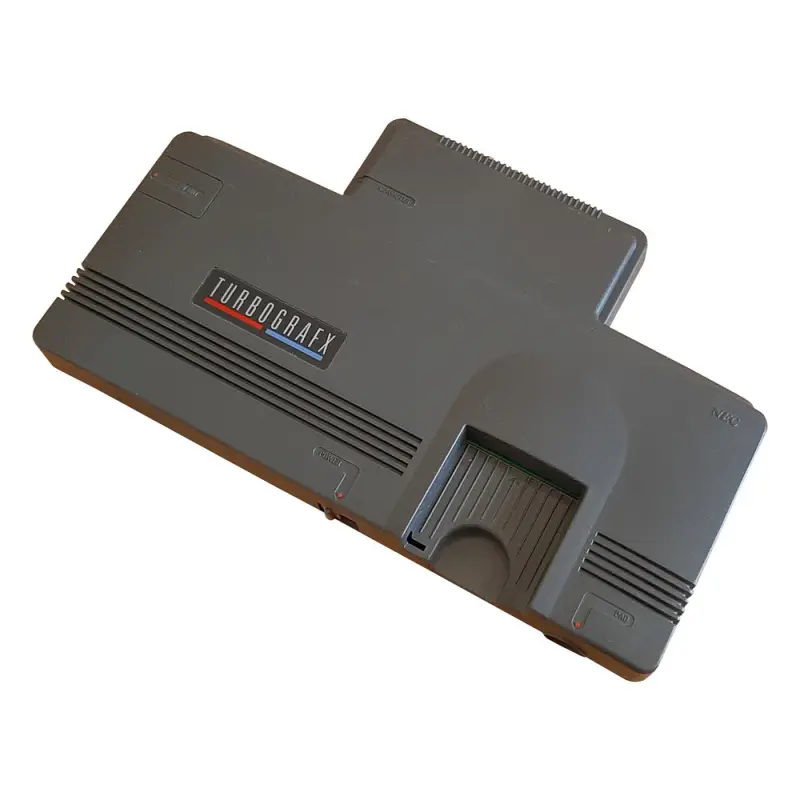
By 1989, NEC was ready to conquer North America and released the PC Engine in the United States and Canada on August 29, 1989, under the name TurboGrafx-16. The name implied that the TurboGrafx-16 was a fully 16-bit console, which it wasn’t. This seems to have been a marketing decision, as the TurboGrafx-16 was released in America only two weeks after the Sega Genesis, a true 16-bit system. While the TurboGrafx-16 was not an under-performing console by any means when compared to the Sega Genesis, it never gained the foothold in North America that Sega had. Also, Sega, which had beaten Nintendo to the 16-bit era, ran an aggressive marketing campaign to take over as much market share as possible before the release of the Super Nintendo. All of these factors led to poor sales in North America.
In 1989, the Guillemot brothers, who had just started a video game publishing company called Ubisoft, created a new company dedicated to importing the Japanese PC Engine into France. It was called “Société de Distribution de la PC Engine”, or Sodipeng, a subsidiary of Guillemot International. Although the imports were unlicensed by NEC, Sodipeng provided French instructions, a custom AV cable to connect the console to a SECAM television and its own warranty. Its launch price was 1,790 French francs.
Meanwhile, NEC was getting ready to release the PC Engine in Europe under the name TurboGrafx (without the “-16” suffix). Production of the console was well underway when NEC decided to pull the plug following disappointing sales in North America. NEC cancelled the plans in early 1990. The stock was sold to Telegames, a well-known British video game publisher.
Release
The TurboGrafx was “officially” released in 1990 in the United Kingdom by Telegames. This model was also released in Spain and Portugal through selected retailers.
Demise
Even with NEC giving up on Europe, the TurboGrafx could have been successful if it had not been for one small detail: the lack of available games. No game was ever produced specifically for the European market. The TurboGrafx was not compatible with the Japanese PC Engine HuCards, which were becoming more available in Europe thanks to the units imported by Sodipeng. In return, it was “fully” compatible with the North American releases. Sadly, since the PAL format runs at 50 Hz, all the North American games ran slower than at their native 60 Hz NTSC speed. But the biggest problem was distribution. With the TurboGrafx being sold in extremely small quantities, importing North American games was not of any interest to local retailers, which in turn discouraged even more potential buyers.
Telegames continued to liquidate its inventory over many years. The system could still be found brand new in the 2010s through liquidators. The remaining systems finally sold out as the retro gaming hobby grew.
Technical Specifications
- Media: HuCard (a credit-card-sized ROM cartridge), plus CD-ROM through the CD-ROM² add-on
- CPU: Hudson Soft HuC6280, a modified 65C02 with an effective clock of 1.79 or 7.16 MHz, switchable by software
- Work RAM: 8 KB
- Video RAM: 64 KB
- Graphics: 16-bit Hudson HuC6270 video chip and HuC6260 color chip, both at 10 MHz
- Resolution: 256 × 239 or 565 × 242
- Colors: 512-color palette, with 482 colors on screen at once
- Colors per palette: Up to 16 colors, made up of 15 colors plus transparency
- Sound: HuC6280 PSG with 6 channels (5 wave and 1 noise)
- Video output: Composite or RF